Structural Health Monitoring
-
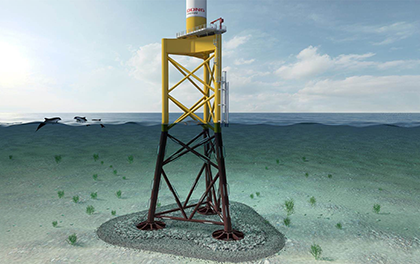
Monitoring the Suction Bucket Jacket at the Offshore Wind Farm Borkum Riffgrund 1 (Monitoring SBJ)The research project “Monitoring SBJ” is a joint project between DONG Energy, Leibniz Universität Hannover (LUH), and the Federal Institute for Materials Research and Testing (BAM). It is based on measured data gathered from the comprehensive monitoring system mounted on the recently installed Suction Bucket Jacket prototype foundation, located at the offshore wind farm Borkum Riffgrund 1. The tasks of ISD are the processing of measurement data from ambient vibration during installation and operation and the improvement of a numerical model in terms of the soil-structure-interaction.Led by: Prof. Dr.-Ing. habil. Raimund RolfesTeam:Year: 2014Funding: Federal Ministry for Economic Affairs and EnergyDuration: 01.08.2014 - 28.02.2017
-
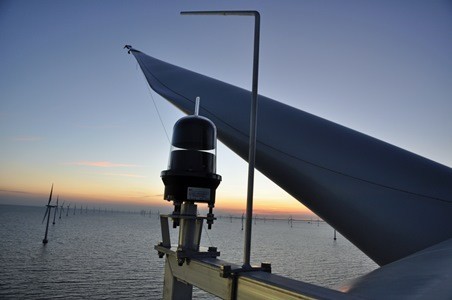
Multivariate Structural Health Monitoring for Rotor BladesEssential goals of the project “Multivariate Structural Health Monitoring for Rotor Blades” are to develop, combine and test global and local SHM methods for rotor blades of wind turbines. In sense of a multivariate procedure, different structure-mechanical and acoustic approaches, which are able to capture different indicators and damage parameters, will be considered. The SHM methods are to guarantee an automated and reliable detection and classification of relevant damages during the early stage.Led by: Prof. Dr-Ing. habil. Raimund RolfesTeam:Year: 2017Funding: Federal Ministry for Economic Affairs and Energy - FKZ 0324157ADuration: 01.03.2017 – 31.12.2020
© ISD
-
Gebrauchstauglichkeit und Komfort von dynamisch beanspruchten Holztragwerken im urbanen mehrgeschossigen Hochbau (DBH)Goal of the research project is the analysis of vibration phenomena of modern urban timber constructions and the development of innovative methods and standards for project planners and developers. In addition, digital measuring data and further results will be published. Due to the increasing demand for wooden buildings in an environment, which is highly dominated by traffic-induced vibrations, the dynamics of multistory buildings become design relevant and more and more urgent. In combination with the sustainability per se of wooden materials, a sufficient planning security establishes the precondition for future multistory buildings to be completely manufactured from wood, which will lead to a more sustainable construction method compared to reinforced concrete. As an outcome, relevant contributions to ensure vibration-dependent comfort characteristics of timber buildings are expected.Led by: Dr.-Ing. Tanja GrießmannTeam:Year: 2018Funding: Deutsche Bundesstiftung Umwelt - Aktenzeichen 34548/01 - 25Duration: 2018- 2021
© iBHolz, Braunschweig
-
Optimierung der Bemessung hybrider Türme und Entwicklung eines geeigneten Monitoringkonzepts (HyTowering)As tower heights continue to rise, hybrid towers made of pre-stressed concrete segments and mounted steel towers are increasingly being used for onshore wind turbines. The risk of instability or damage to the structure increases with height. The subject of the approved research project are large-scale tests on concrete segment towers. It is planned to develop design models and to test monitoring concepts.Led by: Prof. Dr.-Ing. habil. Raimund RolfesTeam:Year: 2018Funding: Federal Ministry for Economic Affairs and EnergyDuration: 01.01.2018 - 31.12.2020
© ISD
-
Quality assured flow production of lightweight UHSC rod elements using artificial neural networksTogether with the Institute of Building Materials Science, ISD is doing research on novel manufacturing processes for components made of ultra-high-strength concrete with a reinforcement of steel sheet and carbon fibres. An innovative extrusion process is used to produce rod-shaped components with a core of ultra-high strength concrete. They are reinforced by a combination of carbon fiber reinforced plastic and sheet steel. A sensor concept is being developed which is capable of monitoring the components "from the birth of the component". Various heterogeneous measurement data are used to control and monitor the extrusion process by means of an artificial neural network, so that a consistently high quality of the components can be guaranteed.Led by: Prof. Dr.-Ing. habil. Raimund RolfesTeam:Year: 2019Funding: Deutsche Forschungsgemeinschaft (DFG) - Projektnummer 402702316Duration: 2019 - 2022
-
SONYA: Increasing the reliability of segmented rotor blades through Hybrid condition monitoringThe aim of the project is to ensure the reliability of future, complex rotor blades with new structural technologies through targeted and reliable monitoring of the structural condition and to increase the overall availability of the plant. The research focus is on the development and application of a hybrid, intelligent structural monitoring system using the example of a highly loaded joint from a segmented rotor blade. This system will combine independent component monitoring systems (ultrasonic and strain-based) into a hybrid system, thereby increasing the reliability and accuracy of damage detection. For this purpose, it is particularly necessary to avoid false positives of the monitoring system. In this context, the ISD will deal with the application of machine learning methods for the hybrid SHM system when evaluating the measurement data.Led by: Prof. Dr-Ing. habil. Raimund RolfesTeam:Year: 2020Funding: Bundesministerium für Wirtschaft und Energie - Projektnummer 60451751Duration: 01.07.2020-30-06-2023
© DLR
Acoustics
-
Design, realisation and verification of low noise construction methods and noise reduction techniques during construction of offshore wind turbines (Schall 3)Goal of the project is the development and testing of practicable and efficient mitigation concepts to minimize the impact on the marine fauna during the construction of offshore wind turbines. It is planned to optimize the acoustic relevant parameters of the hydraulic pile driving process in numerical simulations as well as the optimization of pile sleeves and of different bubble curtain concepts.Led by: Prof. Dr.-Ing. habil. Raimund RolfesTeam:Year: 2007Funding: Federal Ministry for the Environment, Nature Conservation, Building and Nuclear Safety - FKZ 0327645Duration: 2007-2011
-
Research on and testing of noise mitigation measures during the construction of the FINO3-monopile (Schall FiNO3)The research project aims at the prototypic application of a big bubble curtain during the pile driving activities to install the FINO3-research platform in the German North Sea. It is planned to evaluate the efficiency of the mitigation concept to protect the marine environment against sound immissions during a short test program subsequent to the main piling procedure. In parallel, measures within the ecological accompanying research will be taken.Led by: Prof. Dr.-Ing. habil. Raimund RolfesTeam:Year: 2008Funding: Federal Ministry for the Environment, Nature Conservation, Building and Nuclear Safety - FKZ 0325023ADuration: 01.01.2008 - 31.03.2009
-
Investigation of Sonar Transponders for Offshore Wind Farms and Technical Integration to an Overall ConceptOffshore Wind Energy Converters require the installation and operation of sonar transponder units in order to achieve an acoustical warning of submarines. In order to assure a sufficient signal-to-noise ratio and a certain operation distance even under bad conditions the source level of the sonar transponder has to be high enough. On the other hand the bad influence on marine mammals has to be minimized. Beside the dimensioning of the transponders according to the requirements of the German navy an additional goal is the modeling of the sound propagation by means of a hybrid approach.Led by: Prof. Dr.-Ing. habil. Raimund RolfesTeam:Year: 2009Funding: Federal Ministry for the Environment, Nature Conservation, Building and Nuclear Safety - FKZ 0325104ADuration: 01.02.2009 - 31.03.2011
-
Realistic underwater noise scenarios on the basis of forecasting models and monitoring for the construction of offshore wind farms in the German North Sea (HyproWind)The research project aims at the development of a multi-stage numerical method for the prediction of underwater sound immissions related to pile driving in the German North Sea. The focus is not on the modeling of the source, but on an efficient calculation of the sound propagation for longer distances with a subsequent visualization in noise maps. Moreover, hydro-acoustic long-term measurements for model validation near the research platforms FINO1 and FINO3 are planned.Led by: Prof. Dr.-Ing. habil. Raimund RolfesTeam:Year: 2010Funding: Federal Ministry for the Environment, Nature Conservation, Building and Nuclear Safety - FKZ 0325212Duration: 01.09.2010 - 31.12.2013
-
Predicting Underwater Noise due to Offshore Pile Driving: Modeling of Noise Reduction Methods (BORA)The global target of the joint project BORA is to develop a calculation model to predict waterborne noise due to offshore pile driving. This includes especially models to predict the sound development at the source due to pile deformation and vibration, the sound transmission into water and soil and the consideration of the sound attenuation due to the air-water mixture produced by bubble curtains or due to other sound reduction methods.Led by: Prof. Dr.-Ing. habil. Raimund RolfesTeam:Year: 2012Funding: Federal Ministry for Economic Affairs and Energy - FKZ 0325421BDuration: 01.12.2009 - 30.11.2014
-
From the source to the perceptionIn the project WEA-Akzeptanz an interdisciplinary approach will be followed, which links the physical sound generation, radiation and propagation with the perception at the immission site. In cooperation with the industrial partner Senvion, the IKT and the IMUK of the Leibniz Universität Hannover, an acoustic overall model will be developed comprising the sound generation at the wind turbine, the sound propagation to the receiver under realistic atmospheric conditions and a perception model.Led by: Prof. Dr-Ing. habil. Raimund RolfesTeam:Year: 2017Funding: Federal Ministry for Economic Affairs and Energy - FKZ 0324134ADuration: 01.04.2017 – 30.11.2020
© ISD
-
Development of an AI-based Geographic Information System for the Selection of Wind Energy Potential Sites within the Context of Species Conservation, Environmental Protection, and Climate Protection (WindGISKI)The aim of the project is to develop and evaluate an AI-based GIS system to identify suitable areas for wind turbines. The identification process will be automated and systematized through the use of modern technologies, with special consideration of immission, environmental, species and climate protection aspects. A significant improvement in both the quality and quantity of potential wind turbine sites is being aimed for. The focus of the ISD includes the combination of a sound simulation model with GIS data and the implementation of a shadow impact simulation.Led by: Prof. Dr.-Ing. habil. Raimund RolfesTeam:Year: 2021Funding: Federal Ministry for the Environment, Nature Conservation, Nuclear Safety and Consumer ProtectionDuration: 01.12.2021 – 30.06.2025
Coupled Dynamic Systems
-
Life time - Research on Support Structures in the Offshore Test Site alpha ventus (GIGAWIND life)Goal of the comprehensive project is the enhancement of the economic dimensioning concept for offshore wind turbine support structures, that has been developed in GIGAWIND alpha ventus, by consideration of long-time operation. There are both degradation mechanisms on the resistance side of the environmental surrounded support structure (damages of structure and welds, fatigue, damages of corrosion protection systems, scour, degradation of pile support behavior) and the determination of acting loads from waves and marine growth.Led by: Prof. Dr.-Ing. habil. Raimund RolfesTeam:Year: 1000Funding: Federal Ministry for Economic Affairs and Energy - FKZ 0325575ADuration: 01.02.2013 - 31.01.2018
-
Suction bucket foundations as an innovative and installation noise-reducing concept for offshore wind turbines (WindBucket)The overall goal of the research project „WindBucket“ is to assess the feasibility and possible applications and limitations as well as creating necessary conditions for planning, design and construction of bucket foundations of steel and reinforced concrete in German offshore fields. The tasks of ISD include the preparation of an integrated multi-physical model of the offshore wind turbine to study the dynamic behavior applying modal analysis and transient simulation under the consideration of soil-structure-interaction.Led by: Prof. Dr.-Ing. habil. Raimund RolfesTeam:Year: 2012Funding: Federal Ministry for Economic Affairs and Energy - FKZ 0325406BDuration: 01.07.2012 - 30.09.2014
-
Innovative Wind Conversion Systems (10-20 MW) for Offshore Applications (INNWIND.EU)The research project with a total of 27 European partners is an ambitious successor for the UpWind project, where the vision of a 20MW wind turbine was put forth with specific technology advances that are required to make it happen. The overall objectives of the INNWIND.EU project are the high performance innovative design of a beyond-state-of-the-art 10-20MW offshore wind turbine and hardware demonstrators of some of the critical components.Led by: Prof. Dr. Ing.-habil. Raimund RolfesTeam:Year: 2012Funding: European UnionDuration: 01.11.2012 - 31.10.2017
-
Probabilistic Safety Assessment of Offshore Wind Turbines (PSA)In diesem themenübergreifenden Verbundprojekt soll die für den Bemessungsprozess zentrale Frage der Versagenswahrscheinlichkeit in den aktuellen Bemessungen von OWEA geklärt werden. Hierfür werden mit Hilfe von probabilistischen Methoden Versagenswahrscheinlichkeiten für die Grenzzustände berechnet. Die vorhandenen Versagensarten der Tragstruktur werden in einer Fehlerbaumanalyse zusammengeführt und die wahrscheinlichste Versagensart sowie die resultierende Versagenswahrscheinlichkeit können bestimmt werden.Led by: Prof. Dr-Ing. habil. Raimund RolfesTeam:Year: 2014Funding: Ministry for Science and Culture in Lower SaxonyDuration: 01.12.2009-30.11.2014
-
Dynamical behavior and strength of structural elements with regeneration induced imperfections and residual stresses (SP B4 "Stochastic Structural Analysis" of CRC 871)Real components comprise regeneration induced imperfections (geometry, material and residual stresses), that affect the structural behavior significantly. For the application example of the complex capital good of a compressor blisk, the regeneration influence is quantified in the starting dynamics and durability. The bases for the necessary probabilistic structural analysis are efficient computation approaches. Finally, an evaluation of the possible regeneration paths (competing and non-competing) is performed.Led by: Prof. Dr.-Ing. habil. Raimund RolfesTeam:Year: 2014Funding: German Research Foundation (DFG)Duration: 2010-2021
© ISD
-
Integrated Research Programme on Wind Energy (IRPWIND)The aim of the IRPWIND is to foster better integration of European wind energy research activities with the aim of accelerating the transition towards a low-carbon economy and maintain and increase European competitiveness. IRPWIND focusses on three main research aspects. The first one is the optimization of wind farms through the validation of integrated design models. The second one is the reduction of the uncertainty in order to increase efficiency and reliability of future wind turbines. The last one is the transformation of the energy supply system.Led by: Prof. Dr.-Ing. habil. Raimund RolfesTeam:Year: 2014Funding: European UnionDuration: 01.03.2014 - 30.04.2018
-
Joint research for raising the efficiency of wind energy converters within the energy supply system (ventus efficiens)The research project focuses the efficiency of wind energy converters within the energy supply system. Although the production, installation and operation procedures of these are on a high level, a continuous raise of their efficiency is indispensable. Only with a constant raise in efficiency, costs of electricity can be reduced distinctly. For wind energy, this is of special interest due to the essential role that it will have in Europe’s future energy supply.Led by: Prof. Dr.-Ing. habil. Raimund RolfesTeam:Year: 2015Funding: Ministry for Science and Culture of Lower SaxonyDuration: 01.12.2014 - 31.12.2019
© ForWind
-
Precise measuring system for contactless recording and analysis of the dynamic flow behaviour of wind turbine rotor blades (PreciWind)Within the framework of the PreciWind project, a mobile thermographic measuring system for the continuous recording and analysis of the dynamic flow behaviour of rotor blades on wind turbines in operation is being developed. With the system developed for use on operational turbines in wind parks, the aerodynamic performance of wind turbines in operation can be quantified and evaluated. The analysis of the boundary layer flow conditions is carried out with a geometrically high-resolution infrared camera in the long-wave radiation range. In combination with a laser distance measuring system to record the rotor blade distance and geometry, the measuring system is fixed on a co-rotating measuring system carrier in order to examine the flow behaviour during a complete revolution of the rotor for the first time. This arrangement enables the compensation of the relative movements between the measuring system and the wind turbine rotor and at the same time enables an analysis of the structural dynamics of the wind turbine due to changing force effects within a rotor revolution. Using a mobile power supply, measurements can be carried out in real wind park conditions from distances of up to 300 m to the wind turbine. The main task of the ISD is to numerically investigate the full measuring activities by applying the concept of a digital twin. A virtual image of the wind energy turbine and the entire measurement system will be designed in detail. To determine effective positions and adjustments of the measurement system, various simulations under different environment conditions will be performed. A validation of the simulations is carried out using high-quality measurement data.Led by: Prof. Dr-Ing. habil. Raimund Rolfes, PD Dr.-Ing. habil. Cristian Guillermo GebhardtTeam:Year: 2020Funding: Bundesministerium für Wirtschaft und Energie - FKZ 03EE3013BDuration: 01.01.2020 – 31.12.2022
© BIMAQ
Uncertainty
-
Efficient modelling of wind turbines in time-domain considering uncertain parameters (ENERGIZE)Wind energy is a promising technology to achieve the objectives set for the development of renewable energy. To increase competitiveness, costs have to be reduced and the structural reliability has to be improved. A promising approach are more realistic simulations of wind turbines by considering polymorphic uncertainty. In this context, uncertainty is, for example, variability, incompleteness, and inaccuracy of data. Polymorphic uncertainty can be modelled by using imprecise probability. In research, for classical applications of civil engineering, imprecise probability becomes increasingly popular in recent years. However, for wind turbine applications, there are no approaches that use imprecise probability. The main reason is the complexity of wind turbines that combine challenges regarding uncertain and scattering inputs (typical for civil engineering) and complex controller actions (typical for mechanical and electrical engineering). This complexity leads to high computing times and hinders accurate meta-modelling, that is normally used, if computing times are not manageable. That is why in this project, at first, adequate imprecise probability methods are applied to wind turbine models. Subsequently, the efficiency of the uncertain analysis is increased by reducing the required number of model evaluations. This is the core of this project. First, the increase in efficiency is achieved by using enhanced sensitivity analyses, which can be applied when imprecise probability is utilised. By means of sensitivity analyses, the number of uncertain parameters can be reduced. Second, sampling techniques are developed, which can be combined with imprecise probabilities and load extrapolations for wind turbine fatigue loads. This enables an efficient modelling of complex wind turbines using polymorphic uncertain data. At the same time, computing times are kept manageable. Hence, more realistic simulations are possible.Led by: Prof. Dr.-Ing. habil. Raimund Rolfes, Dr.-Ing. Cristian GebhardtTeam:Year: 2019Funding: Deutsche Forschungsgemeinschaft (DFG)Duration: 2019 – 2022
© ISD
-
VIPile – Influence of vibration parameters on the installation and load-bearing behaviour of monopilesThe results of the first two rounds of auctions for German offshore wind farms with commissioning from 2021 to 2025 illustrate the necessity of exploiting further cost reduction potentials in order to realise these future projects within the targeted cost ranges. One possibility is the use of vibratory pile driving as an environmentally friendly and cost-effective construction method for the realisation of further expansion plans for offshore wind energy in Germany. The VIPile project pursues the overall goal of developing validated simulation models for predicting the load-bearing behaviour of vibrated monopile foundations by means of large-scale experiments and numerical simulations. This aims at enabling an economic evaluation and reducing the corresponding risks during project realisations. In addition, a simplified, less computationally intensive, linearized soil-structure interaction model will be developed, which can be integrated into fully coupled aero-elastic wind turbine simulations. This simplified model will be derived from the previously developed detailed models and validated with the help of dynamic measurements. The focus of the ISD is on the simplified soil-structure interaction model.Led by: Prof. Dr.-Ing. habil. Raimund Rolfes, Dr.-Ing. Clemens HüblerTeam:Year: 2020Funding: Bundesministerium für Wirtschaft und Energie - FKZ 03EE3022Duration: 01.08.2020 – 31.07.2023
© ISD
-
Transdisciplinary end-of-life analysis of wind turbines for the development of technically and economically optimal end-of-funding strategies (TransWind)Wind energy is an important pillar for achieving the energy transition in Germany. Electricity generation costs are still high in relation to market compensation, so that there is a need for development. Hence, the end-of-life topic of wind turbines - i.e. the analysis and design of the period after the end of the funding by the “Erneuerbare Energien Gesetzes” (EEG) or after the design lifetime has been exceeded – is currently of particular interest. To develop technically and economically sustainable strategies for post-EEG wind turbines, a joint and at least partly coupled consideration of different aspects of structural dynamics, logistics, spatial planning, and economics is indispensable. For example, it only makes sense to analyse the economic feasibility of continued operation by retrofitting if this is also technically possible. Therefore, within TransWind project, a probabilistic, structural-dynamic model of a wind turbine will be combined with site-specific wind simulations, spatial planning tools and economic analyses in an integrated modelling approach. To enable the automated application of this transdisciplinary approach, the modelling approach will be implemented in a software solution, and thus, takes advantage of the increasing digitalisation of the energy industry. The focus of the ISD is on the structural-dynamic, probabilistic lifetime calculations.Led by: Dr.-Ing. Clemens Hübler, Prof. Dr-Ing. habil. Raimund RolfesTeam:Year: 2020Funding: Federal Ministry for Economic Affairs and Energy - FKZ 03EE3029ADuration: 01.11.2020 – 31.10.2023
© WIV GmbH